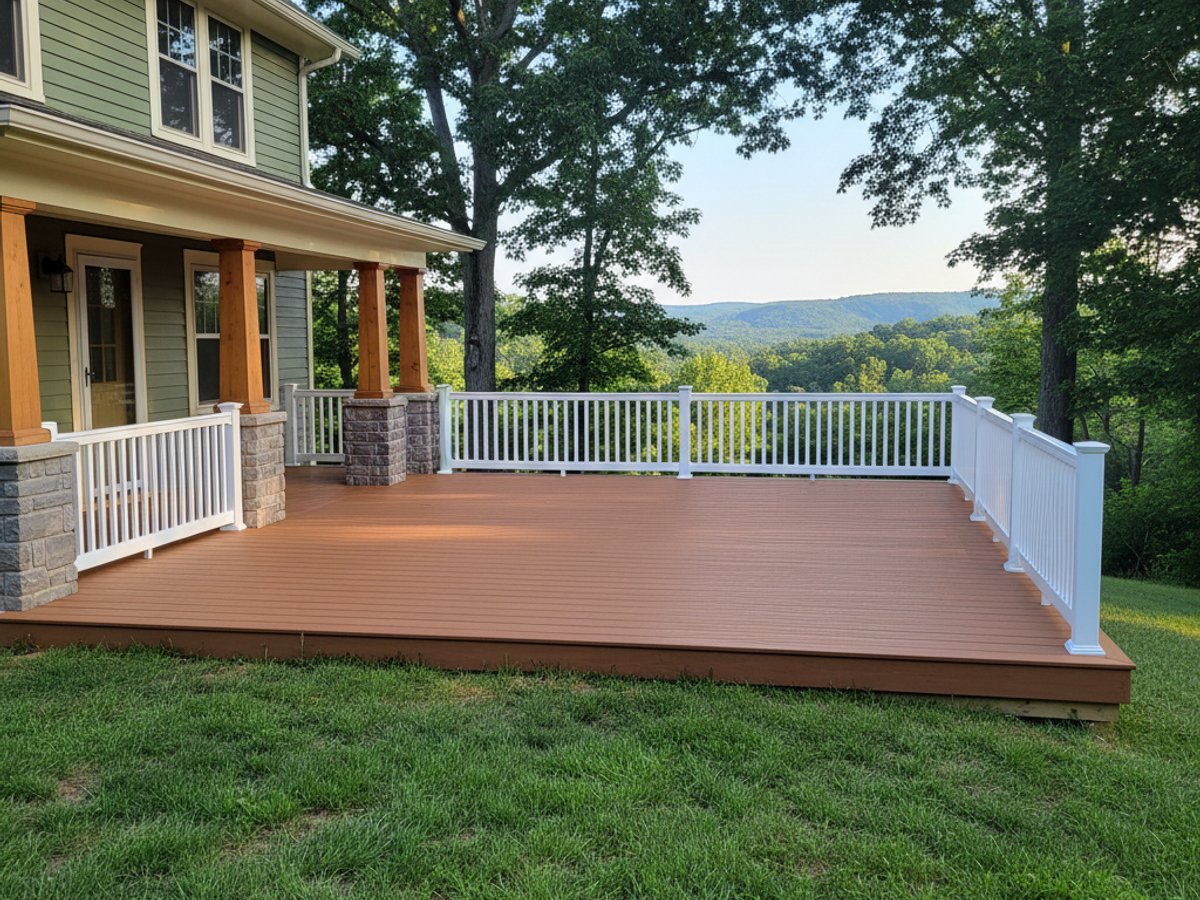
Benton sits on clay soil for the most part, with some rockier ground toward the west side of Saline County. Clay swells when it's wet and shrinks hard when it dries out, and that movement is the number one thing that separates a deck that stands still for twenty years from one that starts wobbling in three. Any builder you talk to should know this without you bringing it up. If they don't mention footings in the first five minutes, that tells you something.
Ask how deep the footings are going
Most decks around here need footings at least 12 to 18 inches below grade, and on some lots with heavier clay you want to go deeper still. A footing that's too shallow will heave when the ground freezes and thaws through a Central Arkansas winter, and while we don't get the brutal freeze-thaw cycling of the Midwest, we still see enough of it from December through February to move a post that isn't set right. Ask the builder how they're sizing the footing to the deck's actual load, not just pouring a standard tube of concrete because that's what they always do. A deck attached to the house with a ledger board carries different weight than a freestanding deck out in the yard, and the footings should reflect that.
Ledger board attachment matters more than people think
The ledger board is the piece bolted to your house that the whole deck hangs off of. If it's not flashed correctly, water gets behind it and starts rotting the house's framing, not just the deck's. A builder who knows what they're doing uses proper flashing, lags the ledger with 3/8-inch bolts into solid framing, not just the siding, and won't just nail it up and move on. This is one of the most common failure points on older decks we see get torn off and rebuilt, and it's almost always because it was done fast the first time.
Permits and what the city actually checks
Inside Benton city limits, most deck additions need a building permit, and if you're attached to the house that permit usually gets pulled before framing starts, with an inspection after the footings are in and another once the framing's up. If your property sits outside city limits in unincorporated Saline County, the process runs through the county instead. Either way, a builder who tells you permits aren't necessary for your project should make you nervous, because that's often the same builder who isn't setting footings deep enough to pass inspection anyway. If you're in one of the newer subdivisions off Alcoa Road or out toward Hurricane Lake, check whether your HOA has its own rules on deck height, railing style, or how close you can build to the property line. Older neighborhoods closer to downtown Benton usually don't have an HOA to deal with, but the houses are older too, which means the foundation and framing the deck ties into may not be square or level anymore. That changes how the ledger board goes on and sometimes means more repair work than the homeowner expected going in.
What they build it out of, and why it matters here
Pressure-treated pine is still the most common frame material and it's a fine choice, but it needs to season before it gets stained or sealed, usually 60 to 90 days depending on how wet the summer's been. A builder who wants to seal it the week it's installed either doesn't know that or is rushing to get to the next job. Composite decking skips that waiting period and holds up better against Arkansas humidity, but it expands and contracts with heat, so the boards need a real gap between them, often around 1/8 inch, or you'll get buckling by the second August. Ask what gap they're leaving and why. If they shrug, that's a sign they're installing composite the same way they'd install wood, which isn't the same job.
What should make you walk away
- No proof of license or insurance. Ask to see it, don't just take their word.
- A quote with no line items, just one number for the whole job.
- Someone who wants full payment up front, before any material is on site.
- A builder who can't tell you what species or grade of wood they're using, or whether the fasteners are rated for treated lumber. Standard steel screws corrode fast in treated pine because of the chemicals in the treatment, and a builder who doesn't know to use coated or stainless fasteners is going to hand you a deck full of rust streaks in two years.
- Anyone who tells you a permit isn't needed for an attached deck. It almost always is.
What a solid quote actually looks like
A good builder comes out and looks at your yard before they price anything. They'll check the slope, because a lot of Benton lots grade toward the back and a deck built without accounting for that ends up funneling water straight at your foundation during a heavy spring downpour. They'll ask if you want wood or composite and explain the tradeoff in maintenance, not just price. And they'll give you a rough timeline, since a standard 12x16 deck usually runs somewhere between a week and ten days from footings to final boards, weather depending, and Arkansas spring rain can push that back more than people expect.
None of this is complicated once you know what to ask, but most homeowners are pricing a deck for the first time and don't know the right questions until something's already gone wrong. If you want a second opinion on a quote you've already got, or you're starting from scratch, take a look at our deck builder work around Benton and give us a call before you sign anything.